From a stronger start to measurable value
What difference can the right start make in the life of a turkey?
For nearly 80 years, the Huisinga family and the businesses that now make up Life-Science Innovations (LSI) have pursued that kind of question—challenging conventional practices, embracing new technologies, and finding practical ways to improve performance throughout the turkey industry.
Next Nest Hatching represents the latest chapter in that tradition. When LSI was introduced to HatchTech’s HatchCare technology, originally developed for the chicken industry, its research and development team recognized an opportunity to bring the benefits of early feeding to commercial turkey production.
To explore how innovative incubation technology is creating new opportunities for turkey producers, HatchTech spoke with Jonathan Huisinga, Board Member of LSI and General Manager of Next Nest Hatching, and Peter Gruhl, Sales Director at LSI and Next Nest Hatching.
Huisinga, a fourth-generation member of the family’s turkey businesses, has seen firsthand how technology can transform established practices. Gruhl brings more than 30 years of experience across breeding, commercial production, technical service, and sales, giving him a practical understanding of the challenges facing turkey producers.
LSI and HatchTech collaborated to develop HatchCare specifically for turkeys. That project ultimately gave rise to two LSI-owned sister companies with complementary missions: Headstart Hatching, established to operate the technology at commercial scale and validate its performance under real production conditions; and Next Nest Hatching, created to bring HatchCare for Turkeys to producers across the industry. Next Nest holds the exclusive distribution rights for HatchCare in the turkey industry.
The results have been impressive. Performance data collected from millions of poults demonstrate improvements in hatch performance, body weight, feed conversion, and breast meat yield. With several major projects underway, HatchCare is gaining momentum in the U.S. turkey industry and could soon represent close to 40% of domestic turkey hatching capacity.
The Right Start from the Moment of Hatch
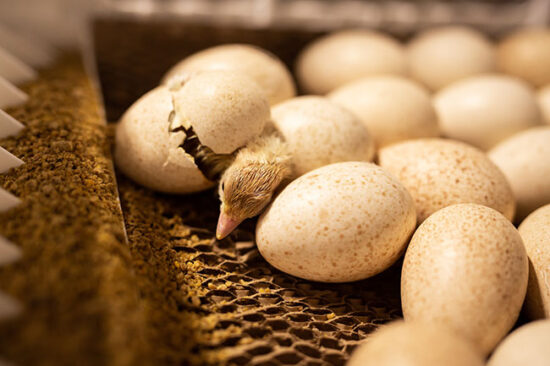
Traditional hatchery systems require poults to remain in the hatcher until the entire hatch window is completed. As a result, poults that hatch early may wait many hours before receiving feed and water.
HatchCare changes that process.
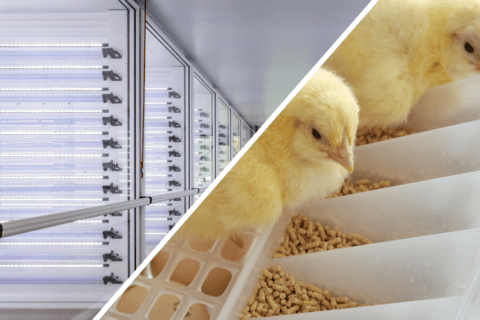
From the moment they hatch, poults have access to fresh water, feed, and light. Early-hatching poults can begin eating and drinking right away, while later-hatching poults have the time they need to complete the hatch process under appropriate conditions.
Developing HatchCare for Turkeys required more than simply scaling up the existing broiler concept. Turkey eggs are larger, poults have different physical characteristics, and their thermal requirements differ from those of chicks.
HatchTech and LSI worked closely together to adapt the system specifically to the biological requirements of turkey poults while maintaining the efficiency, reliability, and scale necessary for commercial hatchery operations.
For Huisinga, the opportunity was about more than improving a single stage of production.
“We’ve been in the turkey business for a long time, and one thing we’ve learned is that there’s almost always a better way to do something. When we saw what HatchTech was doing for chicks, we thought, ‘We’re going to figure out how to do this with turkeys.’ We could have tried to tackle it on our own, but HatchTech seemed to have the same problem we do—they see something that ought to be possible and can’t resist figuring out how to make it happen. We figured we’d make a pretty good team.”

Proven Under Commercial Conditions
The collaboration moved from research and development into full-scale commercial production at Headstart Hatching in Minnesota. Equipped with 15 HatchCare units, the facility provided the opportunity to put the technology to work, evaluate its performance, and follow the results beyond the hatchery through grow-out and processing.
That decision was central to the development strategy.
“We weren’t going to ask anybody else to take a risk we weren’t willing to take ourselves. So we built the hatchery, put the technology to work, and followed the birds all the way through processing. We wanted to be able to say, ‘Here’s what actually happened,’ not just ‘Here’s what we think might happen.”
The critical question was whether those early advantages would continue to deliver value throughout the production chain. The commercial results suggest they do.
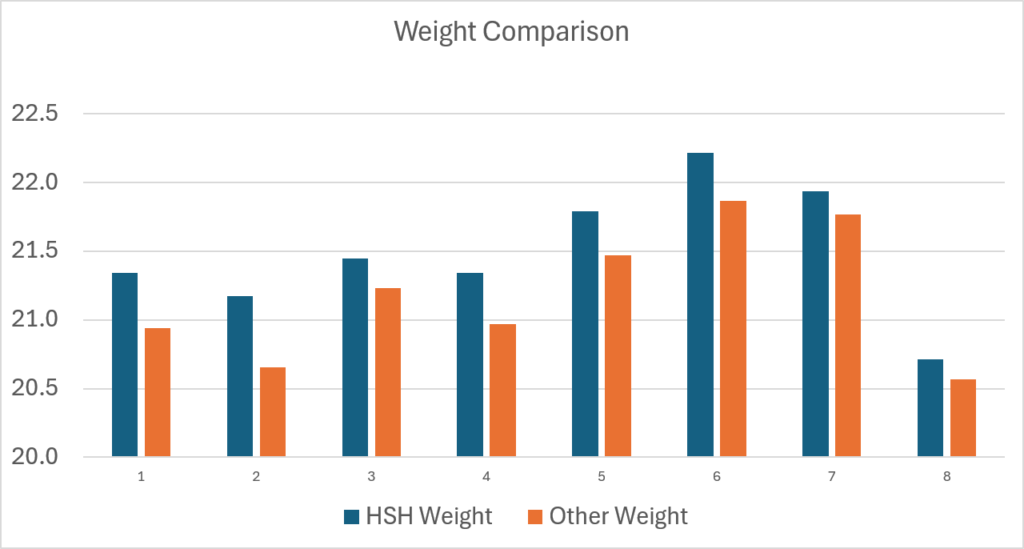
Figure: Tom weight performance in kg across eight anonymised customer regions, comparing Headstart Hatching placements with other placements.
Measurable Improvements Throughout the Chain
Across commercial operations, poults hatched in HatchCare have demonstrated improvements at multiple stages of production:
- Approximately 2–3% improvement in hatch of fertile
- 25–30% higher body weight at pull
- Approximately 20% higher seven-day body weight
- Around 5% higher live weight at delivery
- Up to 7% improvement in feed conversion ratio (FCR)
- Approximately 1% higher breast meat yield
For processors, a one-percent improvement in breast meat yield can translate into substantial volumes of additional high-value product. Improvements in feed conversion can have an equally important impact on production costs, with feed representing one of the industry’s largest expenses.
Together, these results suggest something important: providing poults with a better biological start can also create meaningful economic benefits. For an industry facing continued cost and profitability pressures, that’s a powerful combination.
Backed by Millions of Poults
The findings extend beyond isolated trials.
Performance data have been collected across multiple production regions, representing millions of commercially raised poults.
For LSI, validation meant assessing not only whether the technology worked, but whether its benefits translated into commercial value across production environments.
For Gruhl, that is what makes the results particularly important to turkey producers.
“I’ve worked with turkey producers for more than 30 years, and I can tell you they’re not easily impressed by promises. They want to know what actually works. A better poult at the hatchery is great, but what really matters is how that bird performs all the way to market. When we can show improvements in growth, feed efficiency, and processing yield, that’s when people start paying attention.”
The breadth of the commercial data also provides a foundation for further refinement and evaluation of the technology.
Growing Adoption in the U.S. Turkey Industry
The U.S. turkey industry hatches approximately 320 million eggs annually. Because production is concentrated among a relatively small number of large companies, each new HatchCare installation represents a significant share of industry capacity.
Several major projects are currently underway, including a new hatchery being developed by a large multiplier customer in North Carolina and another large integrated operation in the Midwest.
Together with existing HatchCare capacity at Headstart Hatching, these projects are expected to significantly increase the number of poults receiving immediate access to feed, fresh water, and light from the moment of hatch.
For Huisinga, seeing other producers adopt the technology is one of the most rewarding parts of the project.
“Let’s face it, the turkey industry could use a few more wins. We’ve got some real challenges out there, and nobody’s going to solve them by doing everything the same way we’ve always done it. We took a chance on something we believed in, and now we’ve got the results to back it up. The really exciting part is getting to help other producers put those same improvements to work.”
A Better Start for the Future of Turkey Production
What began as a shared belief that turkey hatching could be done differently has grown into a commercially proven technology with the potential to improve production throughout the industry.
For HatchTech and LSI, the project demonstrates what can happen when complementary expertise, a willingness to challenge conventional thinking, and a commitment to proving results come together.
And for turkey producers around the world, HatchCare for Turkeys offers something particularly valuable: the opportunity to benefit from an innovation that has already moved beyond theory and into commercial reality.
Learn More
Want to learn more about the science behind early feeding?
Discover how immediate access to feed and fresh water supports development during the critical first hours after hatch in HatchTech’s article:
Stimulate Chick Development: The Role of Early Feeding in the First Hours After Hatch