Stimulate Chick Development: The Role of Early Feeding in the First Hours After Hatch
For many years, newly hatched chicks received their first feed and water only when arriving at the farm. As a result, the total time from hatch to first access to feed and water could extend over multiple days.
While this was considered standard practice, research showed that fasting in the first hours after hatch postpones chick development. Feeding and providing water to newborn chicks stimulates their development.
What Does a Newly Hatched Chick Need?
To understand the value of early feeding, it helps to understand what happens biologically during the final stages of embryonic development.
In the last days before hatch, the embryo absorbs the residual yolk into its body cavity. This yolk serves as a nutrient reserve immediately after hatch and can provide energy for maintenance during the first days of life.
For many years, it was assumed that this yolk reserve was sufficient, yet the situation is more complex.
The digestive system is maturing, and the immune system and muscles are developing. Although the chick still has access to nutrients from the residual yolk, immediate access to feed and water supports the development of the digestive and immune systems, helping the chick to make better use of the reserves in the yolk and therefore perform better in later life in terms of growth, disease resilience, and survival.
Fasting in the hatcher and during processing and transport slows the development of the chick.
These findings formed the scientific foundation of HatchTech’s early feeding concept, to stimulate the development of the chick already during the hatch window.
Why Does the Hatch Window Matter?
Chickens do not hatch at the same time. The period between the first and last chick emerging from the shell is known as the hatch window. This window typically takes at least 30 hours and longer in suboptimal conditions.
The hatch window is influenced by several factors, such as egg storage duration and variation in incubation conditions. The influence of these abiotic factors can be minimised by providing optimal, uniform incubation conditions throughout the incubation process. HatchTech’s MicroClimer™ technology is specially designed to provide these optimal, uniform conditions. Nonetheless, even in well-controlled incubation environments, chicks do not hatch at the same time due to biotic factors such as sex or variation in eggshell thickness.
Within standard hatchers, chicks do not have access to food or water. All chicks will be pulled at the same time once the last chicks are expected to have hatched. Therefore, such chicks are prone to dehydration and have fewer nutrients available for the development of their digestive and immune systems, as they use their residual yolk reserves for survival.
That is why it is important to adapt hatchers to the needs of the newly hatched chicks, so they have the best possible development. That is where HatchCare comes in.
Text continues below the video.
How Does HatchCare Fulfil the Needs of the Newly Hatched Chick?
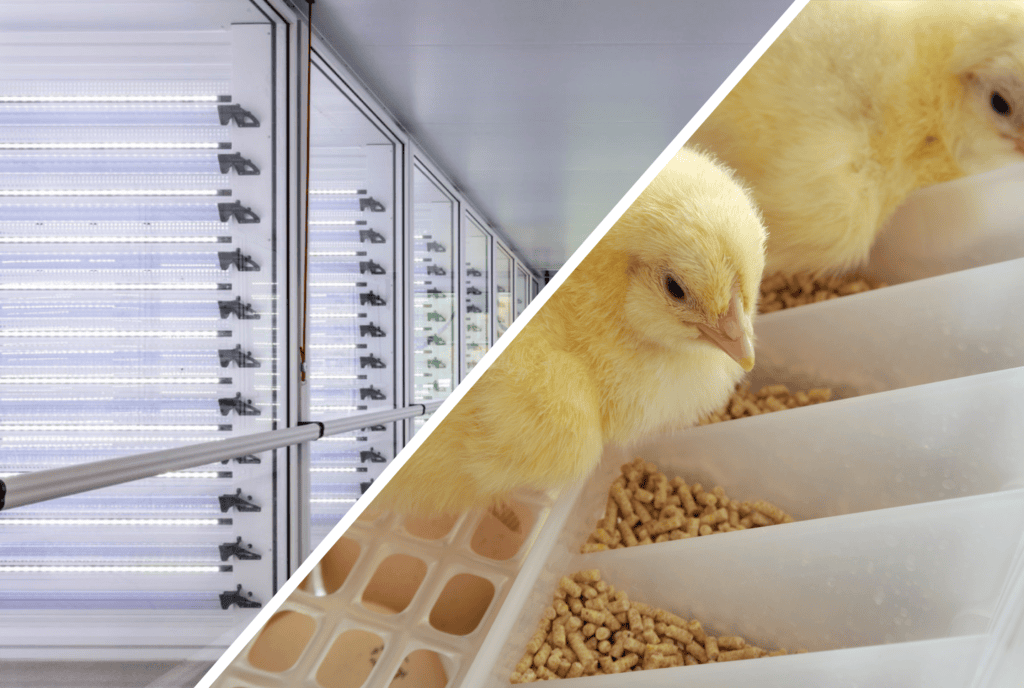
With HatchCare, newly hatched chicks have access to feed, fresh water and light directly after hatch, while they are still in the hatcher. The feed troughs on both sides of the basket provide enough feed until placement on the farm. Fresh flowing water is supplied to the newly hatched chicks using open drinking gutters, stimulating natural drinking behaviour. This prevents dehydration and helps chicks to start their development and gain weight instead of losing it. The well-distributed lighting helps chicks quickly find feed and water and reduces stress that can occur when the door of a dark conventional hatcher opens.
This allows chicks to start optimal development from the moment they emerge from the shell, rather than having to wait and suffer dehydration and malnutrition until they reach the farm.
From Science to Commercial Results
The benefits of early feeding are supported not only by academic research, but also by more than 12 years of commercial experience.
Based on HatchTech field data from a total of 2.500.000 D.O.C. in commercial pair comparisons (Hatched in a MicroClimer hatcher vs. HatchCare hatcher), we found:
- +15,03% D.O.C. weight at pull time
- +10,85% 7-day body weight
- +5,55% live weight upon delivery
- +€6,5 cents additional revenue per chick
These numbers are in line with an extensive scientific report published by non-HatchTech related scientists that performed a meta-analysis of more than 70 studies on early feeding (de Jong et al., 2017).
Customer Case
Annyalla Chicks, the UK’s largest independent hatchery and a long-term HatchTech customer, says the following about the HatchCare concept.
“The hatching results are impressive. We’ve seen hatchability as high as 98%. It’s a healthier chick, a happier chick and a fuller chick.”
Their experience shows how the biological principles behind early feeding can be translated into measurable results in commercial hatchery operations.
Read the Annyalla Chicks customer case
The Takeaway
The digestive tract and its microbiota composition, immune system, and muscles of a newborn chick are developing rapidly after hatch. Early access to feed and water supports the development of the chick whereas delayed access impairs it.
Chicks that can eat and drink perform better later in life compared to those that have to fast until farm placement in terms of body growth, immunocompetence, and survival.
HatchCare gives chicks this opportunity by providing access to feed, fresh water and light from the moment they hatch.
Curious to learn more about the research behind early feeding? Read the full HatchTech research here.